


From Memory to Intelligence: How Organizations Are Learning to Listen at Scale
Conversation data analytics is the problem every company has but few have named. They know they hold too many meetings. They also know decisions get lost. Moreover, the strategy set in the boardroom rarely survives the trip to the people who execute it.
However, they have not yet seen the root cause. In fact, no company has ever had a reliable way to turn talk into structured data — until now.
In short, this is not a tech story. Instead, it is a learning story. As a result, conversation data analytics can save each person 4–5 hours a week, cut write-ups to zero, and turn lost talk into a searchable asset.
How Conversation Data Analytics Builds Institutional Memory
First, consider a typical company in a single week. Leaders run strategy sessions. Meanwhile, managers hold pipeline reviews. Similarly, teams coordinate across time zones. In addition, customer-facing staff run sales, support, and discovery calls.
Each of these talks creates intelligence: commitments, objections, ideas, decisions. However, very little of it gets captured or used. For most teams, the honest answer is almost none.
In other words, the gap is not a will gap. Instead, it is a systems gap. People talk well. Still, they rarely turn talk into reliable, searchable records.
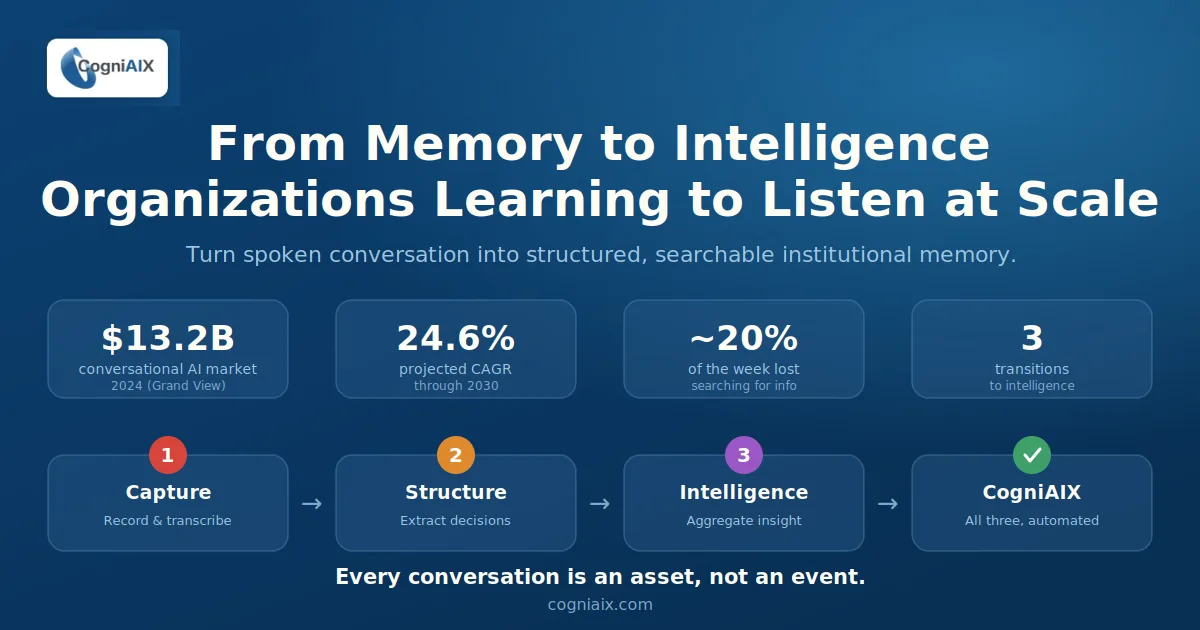
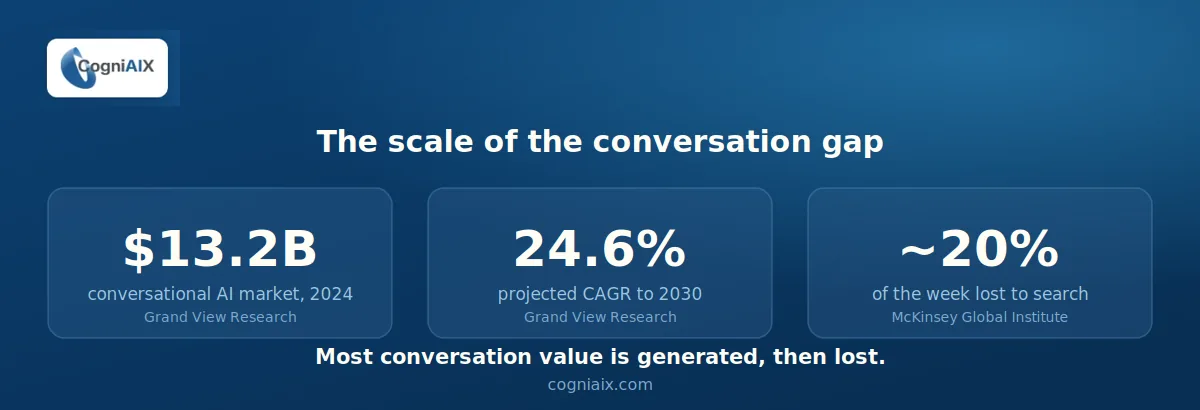
The global conversational AI market hit an estimated $13.2B in 2024 (Grand View Research). Moreover, it is set to grow about 24.6% a year through 2030. Meanwhile, knowledge workers still lose nearly 20% of the week hunting for information they cannot retrieve (McKinsey Global Institute).
Therefore, this is the problem enterprise conversation intelligence solves. Not for one call, but for a whole company learning to listen.
From Event to Asset: Rethinking What a Conversation Is
Most people treat a meeting as an event. It happens, then it ends. The calendar clears. Then people move on. Meanwhile, the decisions live only in memory or half-finished notes.
Instead, treat every conversation as an asset. For example, ask one question. What do you do with a conversation after it ends?
Teams using conversation data analytics answer it in practice. First, the conversation ends. Then the value inside it — decisions, commitments, objections, signals — is captured and structured in minutes. As a result, your team skips the write-up. Moreover, the record joins institutional memory instead of vanishing.
Above all, the shift matters at scale. For example, aggregate insights across thousands of meetings, and clear patterns appear:
- Objection frequency in sales calls reveals product gaps.
- Recurring blockers in projects expose process failures.
- Language drift between leaders and the front line shows alignment gaps early.
In short, none of this works when conversations stay events. However, all of it works when they become assets.
Why Scale Changes Everything
Notably, the value does not grow in a straight line. Instead, it compounds:
- 1 meeting gives you a useful record.
- 10,000 meetings give you a searchable memory.
- 100,000 meetings give you an edge rivals cannot match.
Therefore, the fastest movers treat this as infrastructure, not a tool. For instance, they already built pipelines for transaction data. Now they build them for talk. In fact, the logic is simple. Data you cannot retrieve is data you do not have.
A conversation you cannot retrieve never happened, as far as your company is concerned.
Likewise, the payoff is concrete for one person:
- A sales leader can query 200 calls of buyer signals in seconds. As a result, they spot patterns a rival misses.
- A product team can search every discovery call for one objection. For example, no survey could match that.
- Finally, a CEO can track the drift between strategy and how managers describe it.
The Three Transitions
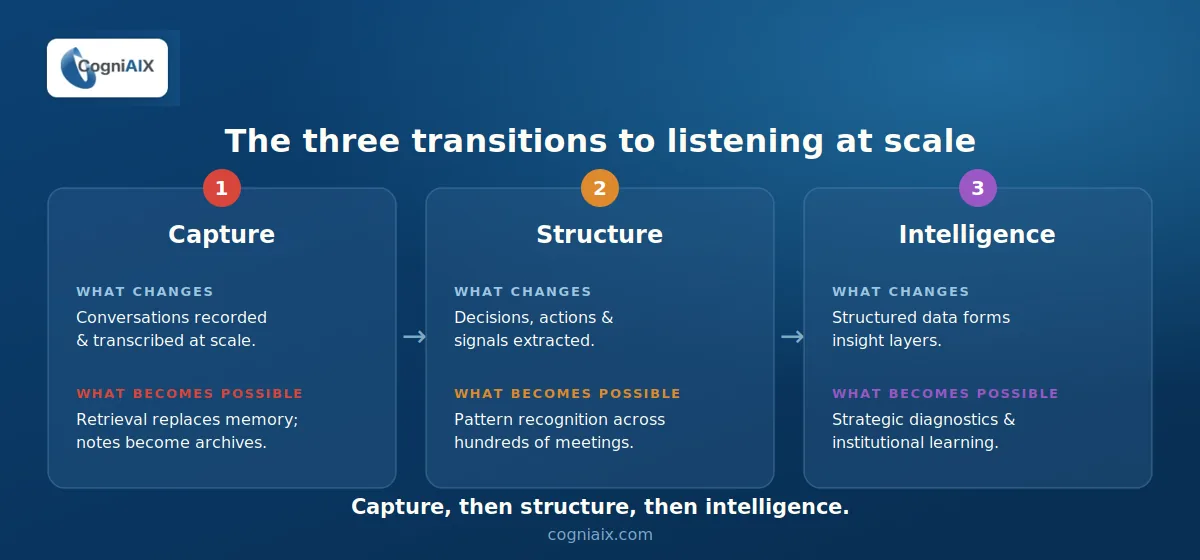
Companies learning to listen move through three clear stages. First, most are partway through capture. Next, fewer finish structure. Finally, very few reach intelligence.
| # | Transition | What Changes | What Becomes Possible |
|---|---|---|---|
| 1 | Capture | Conversations are recorded and transcribed at scale | Retrieval replaces memory; notes become searchable archives |
| 2 | Structure | Decisions, actions, and signals are extracted automatically | Pattern recognition across hundreds of calls at once |
| 3 | Intelligence | Structured data aggregates into insight layers | Strategic diagnostics and learning at scale |
However, most teams think they are further along than they are. For example, using it well is not the same as recording calls. Capture without structure makes archives nobody opens. Likewise, structure without intelligence makes reports nobody reads.
In contrast, the winners reach the third stage. There, the data is not just stored. Instead, it is understood.
One Organization's Shift: From Institutional Amnesia to Institutional Memory
The problem. First, picture Northgate Capital Partners, a 90-person private equity operations team. They ran weekly reviews across 12 active investments. However, the notes depended on whichever analyst showed up.
As a result, principals each lost 2–3 hours a week chasing decisions. Meanwhile, big calls were made with no record of the analysis behind them.
The shift. Then Northgate rolled out conversation data analytics across every review. As a result, each session produced a structured record in minutes. Decisions were logged, commitments attributed, open items flagged — with no manual write-up. In short, the firm moved from memory to a shared, searchable record.
Moreover, insights across all 12 companies surfaced shared patterns. For example, recurring risks that no single review had caught.
The outcome. Within 2 quarters, follow-up questions dropped sharply. More importantly, the archive became a governance asset in its own right. In fact, it showed LPs a rigor the firm could not show before.
"We thought we had a note-taking problem. What we actually had was an institutional memory problem. Conversation analytics gave us a record that the whole firm can trust — not just the people who happened to be in the room." — David Renfrew, Chief Operating Officer, Northgate Capital Partners
The Leadership Imperative
Therefore, the $13.2B figure is not a forecast. Rather, it shows where leaders already are. In short, this is not a category waiting for proof. Instead, it is real for teams that treat talk as an asset.
So the question is no longer "does this work?" Rather, it is "how far behind can we fall?"
Moreover, teams that build this now save hours every week. As a result, they gain an edge that compounds:
- In year 2, decisions draw on a full year of structured data.
- In year 3, they draw on two.
In short, late starters cannot catch that up.
People Also Ask — Conversation Data Analytics
How is conversation data analytics different from a recording archive?
In short, an archive is files nobody opens. However, conversation data analytics structures what was said and makes it searchable in seconds. In other words, the difference is storage versus intelligence.
What is the smallest team that benefits from this?
Even a team of 5 gains fast. For example, it can reclaim 3–4 hours a week in the first month. Moreover, the value grows as call volume rises.
Does this replace our BI or analytics stack?
No. Instead, it sits beside structured analytics. In fact, it captures the spoken layer that BI tools cannot see.
How long does it take to move through the three transitions?
First, most teams finish capture within weeks. Then structure takes a couple of quarters. Finally, intelligence is usually a multi-quarter shift.
What is the first leadership-level use case?
Above all, decision traceability. For example, answering "what did we decide in March?" with a timestamped record is the most consistent first-quarter win.
The Next Frontier of Organizational Intelligence
Finally, the next frontier is not more dashboards. Instead, it is structured intelligence built from conversation data analytics — the richest data you make, and the most wasted until now. Therefore, the teams that grasp this first will shape how companies learn.
Moreover, CogniAIX is built for this moment. It captures every conversation, structures every outcome, and turns lost memory into a usable asset. As a result, it runs on its own, at scale, with no added friction. In short, you save hours, cut follow-up to near zero, automate summaries, and stop losing decisions.
Try CogniAIX free — start capturing and structuring your calls today. For example, your first structured record lands in minutes.
See how CogniAIX builds organizational intelligence at scale.